 Back
Back
One of the most common faults in many “theatre workshops” is insufficient clarity about the ends and, therefore, a haphazard employment of the means, namely, the repertoire of theatre exercises and games. Not surprisingly, the means often become ends in themselves. Another reason for this to happen is the very nature of methods used in a lot of theatre training. The training employs theatre games, and theatre games are fun. They can too easily remain just fun – things done without much internalization.
© Academy of Theatre Arts, Bangalore
With clarity about the ends in training, the trainer can use the repertoire of games and exercises more intelligently, aiding internalization, which is nothing more than a noticeable enhancement of the skills needed by the actor. There are of course several excellent books on training for the theatre. A good example is the introduction by Clive Barker, written long ago. It is as relevant today as then, and a must for every trainer.
There are hundreds of games and exercises that can be used in theatre training. (For convenience, we will use only the word exercises now on.) How do we decide which ones to use in a course? A little bit of ordering and an understanding of what each exercise can do (and cannot do) should help. With the principles understood, the trainer can also improvise with modified or new exercises. It would be useful to remember at the start that many of the exercises commonly done in many drama schools have evolved over several decades. They work well … when used well. That is why they are “standardized”. This is no different from the standardized exercises for the cricketer, sprinter, marathon runner, dancer or gymnast. There is no need to invent exercises only for the sake of novelty when something reliable already exists. A “new” exercise without underlying principles cannot be expected to really help the actor.
REALISTIC OBJECTIVES
What can we expect from a group of newcomers in the limited time of six to seven hours per day over ten to twelve days? Not much, really. But again, we could accomplish quite a lot if we went about it methodically. Expecting to turn out a batch of great actors is obviously an unrealistic expectation. A more realistic set of objectives for the workshop would be on the following lines:
Self discovery – understanding one’s facilities and limitations
Extending range in all the skills needed
Appreciation of the unusual nature of skills needed in the theatre
Appreciation of the discipline, method and rigour needed to acquire a new set of skills
Interest in training methodology and awareness of what goes into it
It is useful to remind ourselves now and then of the larger objective for a group of newcomers: Theatre Appreciation. It is not actor training per se. We are at best providing a glimpse of what goes into the making of an actor. We must also remember the non-commercial status of our enterprise and the workshop. We are not preparing theatre professionals. We should be happy if one or two in every batch opt for a more serious pursuit of the line later. We should have no regrets if none does. Producing plays with them later will still be a lot easier. And … we will be building a more informed audience.
ELEMENTARY TRAINING PRINCIPLES
Trainers must fully understand what they are doing, and why they are doing it. The following principles should aid that understanding.
Experiential methodology
Human behaviour has three “dimensions” to it:
Thinking – our knowledge, beliefs, reasoning
Feeling – our emotional associations
Acting – the willed behaviours (as different from the instinctual / reflex behaviours)
Any enduring change in people must touch all three dimensions. A change in one without a corresponding change in the others is transient and unconvincing.
Most theatre training gets people to do things first (action), then reflect on their experience (feeling states), which leads more easily to a new or altered understanding of things (thinking). This is a far more powerful approach to training – in many fields – than starting with attempts to give information or change thinking. This approach to training is called experiential learning / methodology.
2. Permissive space
Experiential methodology works best when people are allowed to make the connections across thinking-feeling-acting by themselves, and not lectured about them. Two important guidelines for the trainer:
The typical sequence within an exercise would be –
Briefing, focusing on what is to be done, without much on the why
Doing the exercise itself
A review-reflection discussion, moderated by the trainer to aid the closure needed
Minimal “top up” at the end with knowledge / information
There are no evaluative or judgmental comments on the “quality” of execution in the exercise – either from the trainer or to each other within a group. The stress is on experience from the exercise. (And the need to accept the reality of personal experience.) Every experience must be respected, whatever its limitations, and whatever it means to the person. The non-evaluative approach must be established early in the workshop, and reinforced every now and then in the exercises.
Examples of helpful comments to participants in an exercise to stress the non-evaluative, permissive conditions:
Cut out the others watching you
Focus on yourself
This is not a performance
Nobody is going to be judged
What is important is your own experience
Discover for yourself
and so on
Unhelpful ways:
Relax!
Don’t worry
That is not correct
Look at the way she is doing it
and so on.
Evaluative tendencies in participants should be accepted as normal, human, but gently and firmly nipped in the bud.
3. Sequence in the workshop
Some exercises are in the nature of fresh explorations. Some others build on discoveries in earlier explorations. Some skills are elementary. Some are complex, requiring an integration of skills acquired earlier.
The training principle in choosing a particular exercise at a particular time is simple:
THE OBJECTIVE OF THE EXERCISE SHOULD BE ACHIEVABLE.
Motivation for more learning and more effort comes from the experience of achievement in past efforts.
An optimum sequence of exercises in a workshop of ten to twelve sessions is indeed possible to lay down. This is shown in a separate document.
A CLASSIFICATION OF THEATRE EXERCISES
Going back to the question of what an exercise can do, it is possible to view each exercise as best suited for one main area of skills. This is the primary value of the exercise. The exercise might well have some secondary benefits, aiding other skills, but it is important for the trainer to be aware of the primary skill area.
The basic framework used in designing a course has come to be called the golden triangle:
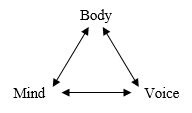
All the skills needed in the actor are located either (a) primarily in one of the three corners of the triangle or (b) in combinations. The repertoire of exercises employed in the BLT introductory workshop (ie. basic skills and knowledge) may be put into the following clusters, based on the skill areas they aid:
Cluster 1 : General appreciation
What is the theatre
Why am I in the theatre
Training in the theatre
Theatre exercises and games
Workshop conventions code of conduct
Cluster 2 : Senses and sensing
Cluster 3 : Range in body states
Cluster 4 : Creative use of body
Cluster 5 : Voice and speech
Cluster 6 : Character research
Cluster 7 : Interpersonal effectiveness
Cluster 8 : Group effectiveness
Cluster 9 : Personal growth
Cluster 10 : Integration in production: good practice, do’s and don’ts.
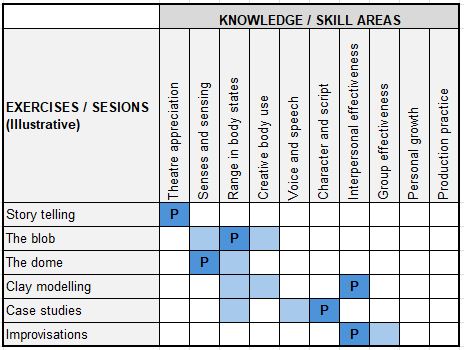
Now, we can chart out a giant “matrix”, in which –
the column heads are the exercise clusters, and
the row heads are specific exercises,
The cells formed by the rows and columns will show the skill areas that each training exercise can aid, with one or two areas of primary value and some of secondary value. For instance, the dome exercise has a primary value in the senses and sensing cluster, but also helps in range in body states and in creative use of the body.
An illustrative “matrix”:
THEATRE EXERCISES : A CLASSIFICATION
With a correct understanding of the value of each exercise, the sequencing in the workshop has a more logical basis.
An optimum sequence
BLT has gone into systematic training since the late ’seventies. Over the years we have explored several different approaches, worked with different methods, and experimented with very many techniques. It is now clear that for a workshop to have a basic minimum impact, we need a minimum of about seven to eight sessions of about five to six hours each. About ten to twelve sessions are ideal. Fourteen sessions aids the end production even better. This has been the standard duration of BLT’s Summer Project on Theatre (SPOT) in recent years, with each session of five to six hours.
The sessions can be on consecutive days (typically done in an out of town engagement), or spread over a longer period. In SPOT, we have spread it over the required number of Sundays. This makes it possible to incorporate the training inputs into a production project, the group working on the project on the weekdays.
The package for the sessions remains the same. It is eclectic, taking useful inputs from several different “schools”, and not wedded to any one “brand” of drama training.
The main advantage of spreading the sessions over a longer period is in the voice work cluster. It is well known that voice exercises must be maintained over at least a month for any noticeable impact. In a one-week engagement the participants can only be shown what to do by themselves in graded steps. They do not have much to see (or hear) by the end of one week. Voice training is also better done gradually, rather than pressure cooked.
An optimum schedule for ten to twelve sessions is presented in a separate document. The logic in the sequencing will be evident to any trainer who has been in a BLT workshop. In actual practice the trainer must be prepared for flexibility in the schedule, putting something off to the next session or bringing in something earlier as needed. Groups (and individuals in the group) vary widely in the amount of time taken for some exercises. It is best to go along with the group’s needs, rather than force-fit a rigid time table. Since the time taken depends considerably on group size, the optimum number for each exercise is also indicated. A minimum group size of ten to twelve is desirable. Fifteen to sixteen appears ideal. Any greater number requires greater skill or experience in the trainer, often calling for parallel sub-groups in exercises.
-Vijay Padaki
